

CIA Brief | 2025 Winter
President’s Memo
Charya Peou
Happy Holidays!
As the year draws to a close, we’re deeply grateful for your unwavering support in preserving Preston Beach, Beach Bluff Park, the sea wall, and the adjoining lot—beloved community treasures maintained by the CIA’s passionate volunteers. This season, consider making a year-end, tax-deductible donation (to the extent allowed by law) to help protect these vital spaces for future generations.
In the coming year, we’ll continue championing our coastal community through education and engaging events—so stay tuned for exciting updates in 2026! Catch highlights from our recent fall event in Alexa Carino-Carr’s article below.
Don’t miss our Winter Solstice Celebration on Saturday, Dec. 21, at 7:10a.m.—a magical way to welcome longer, brighter days. Jim Keating’s article offers fascinating insights into this celestial event.
We’re always excited to welcome new members and volunteers! If you’d like to get involved in our mission, please reach out to learn more about upcoming meetings and how you can connect with our passionate team and community supporters.
Wishing you warmth and joy this holiday season—we can’t wait to see you on the beach in 2026. Your support makes everything we do possible.
CIA Board

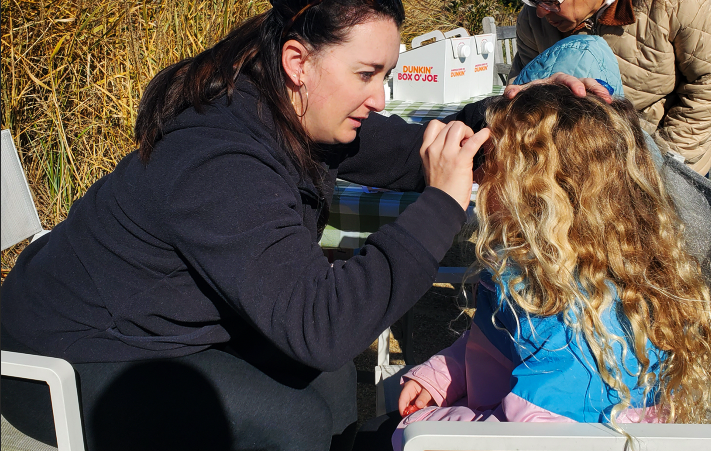

Fall Fun at Beach Bluff ParkA Sunny Fall Day for Community and Crafts
Alexa Jaccarino Carr
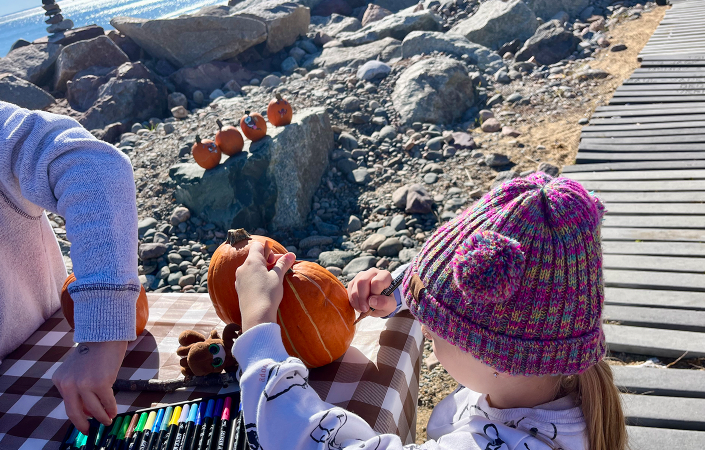
Just over a month ago, the CIA hosted its first ever “Fall Fun at Beach Bluff Park” event—a morning designed to bring families together, celebrate the season, and raise funds to support the association’s ongoing work maintaining Beach Bluff Park, the sea wall, the parking lot, and Preston Beach access.
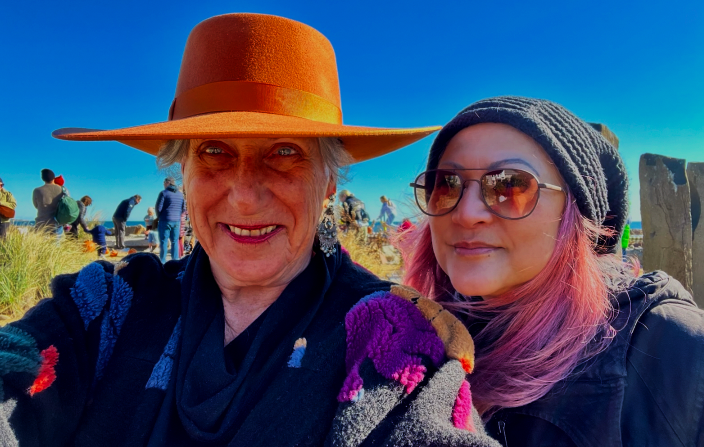
We’re delighted to share that the event was a great success! Around 40 families joined us throughout the event, filling the park with laughter, creativity, and a warm sense of community. Under clear blue skies and sunshine, kids and parents rotated through a series of autumn-themed activities that filled the park with energy.
Kids enjoyed face painting, pumpkin decorating, and playing pumpkin ring toss. Both kids and adults painted rocks–I hope some went on to decorate your Thanksgiving tables or fall gardens.
Thanks go to the enthusiasm and generosity of participating families, and to the dedicated CIA volunteers who helped set up and run the activities. The event raised funds that will directly support the CIA’s mission. We’re deeply grateful for the community’s support and turnout!
This event was also our first foray in recent years of hosting family-oriented and kid-focused programming—and we hope it won’t be the last. We’d like to continue the momentum by offering more seasonal events that bring neighbors together, highlight the beauty of the park, and engage the next generation of park stewards.
If you’d like to help in planning future family-focused events, please reach out! We’d love to hear from you. VicePresident@ciabeachbluff.org
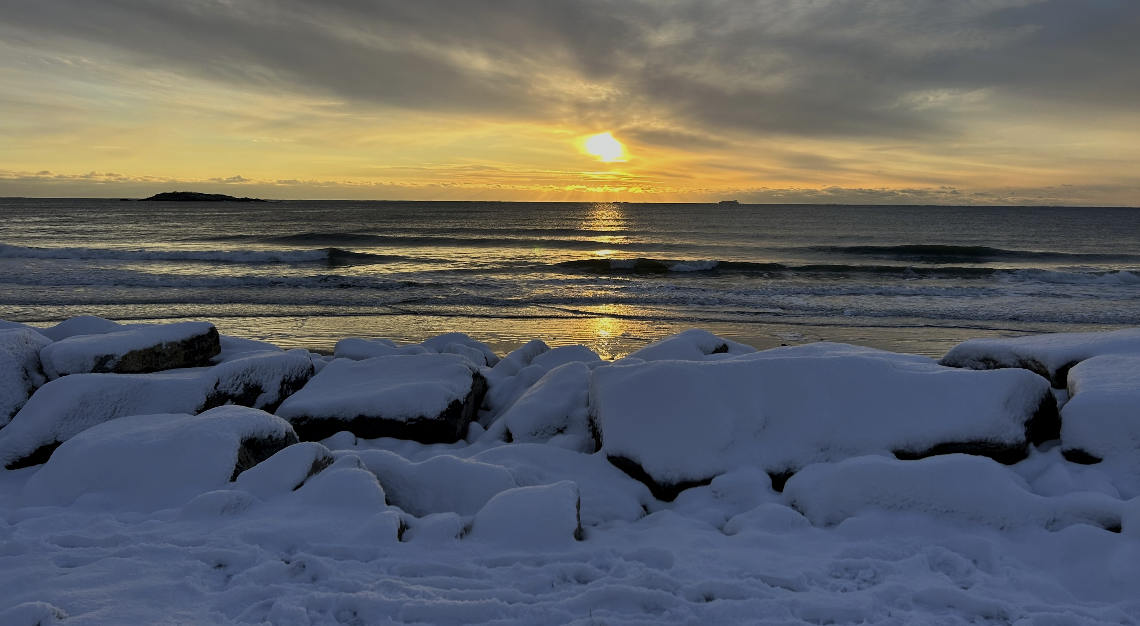
Winter Solstice 2025
James Keating
The Winter Solstice is the moment when Earth’s North Pole is tilted farthest from the Sun. It marks the shortest day and the longest night of the year. It happens in the Northern Hemisphere around December 21-22 and in the Southern Hemisphere around June 21-22.
What happens in the sky? The Sun appears at its lowest point at noon. The days begin to lengthen afterward, a symbolic “return of the light.” Many cultures have celebrated this Solstice for thousands of years.
The above statements are generalities of the Winter Solstice, but for a better understanding, one must look at the details of each specific Winter Solstice. This year’s Winter Solstice occurs on December 21 at 10:03 a.m. EST. One must realize that the Earth is moving around the Sun at 66,615.96 mph. This is the moment that the Earth’s axis is tilted furthest away from the Sun. The Sun will be at its lowest point on the ecliptic plane (an imaginary geometric plane created by Earth’s orbit around the Sun), 23.26 degrees below the celestial equator, at noon on December 21. On two days in December, the 20th and 21st, the Sun rises and sets at the same time (sunrise at 7:10 a.m., sunset at 4:14 p.m.). Why is the solstice not on the 20th? It’s because the maximum tilt is on the 21st.
For those of us who drive in the afternoons, starting December 10, you might have noticed the sunset occurs later each day. Subconsciously, we think the days are getting longer, but the Sun is rising later until January 4th. Also, the shortest days and longest nights occur on Dec. 20, 21, and 22 (14 hours, 56 minutes). So, if one were to stay up all night, they would be able to see almost the entire night sky and all the winter constellations.
Lastly, I mentioned that many cultures have celebrated the Winter Solstice. The reason we know this is because of archaeoastronomy, which is the study of how ancient and prehistoric cultures used astronomy to interpret beliefs, seasons, and their connections to the sky. Maybe in the next 1,000 years or so the archaeoastronomers will find the Sun Circle at Preston Beach and do research here.
We invite you to join us on Sunday, December 21, to welcome winter at the Sun Circle at Beach Bluff Park in Swampscott at 7:10 a.m. Many thanks to Lisa Kawski and Kampa Vashi Deva for leading these ceremonies in spring, summer, fall, and the coldest time of the year, winter.
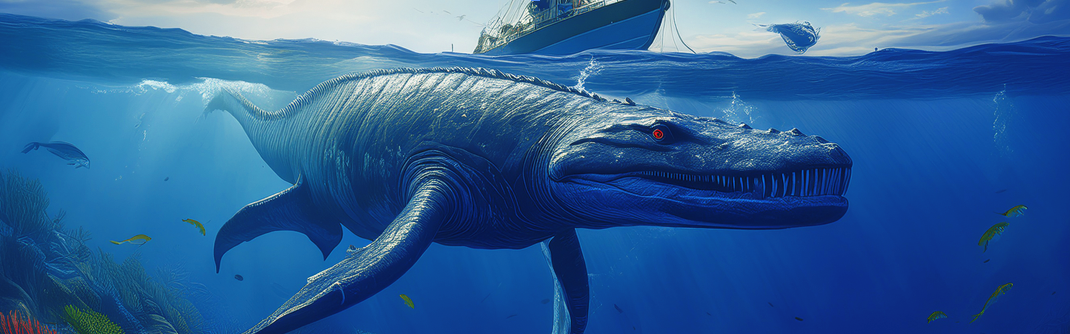
Sightings: Swampscott's Sea Serpent
Nancy Lusignan Schultz, PhDReprinted with permission by Nancy Lusignan Schultz, Ph.D
On Friday, September 2, 1898, one of the last recorded sightings of the famous Swampscott Sea Serpent was reported in the Lynn Daily Item. A group of young sportsmen was sailing back from a day of fishing off Gloucester and, somewhere between Cat and Baker’s Islands, spied the monster outstretched upon the water. The boys stated it appeared to be 150-200 feet in length and enjoying a sunbath, its long, pointed nose tucked into the serpent’s curled body. The account stated that these boys, enjoying summer’s last freedoms before the resumption of school, “…are of a set whose veracity has never been doubted.” In case that was not enough to boost their credibility, it was added, “Nor are they known to take any stimulating beverages which might make them see imaginary things.”
During the 19th century, glimpses of the leviathan were sporadic, but detailed. One of the earliest sightings was compiled as a “Report of a Committee of the Linnaean Society of New England, relative to a large Marine Animal, supposed to be a Serpent, seen near Cape Ann, Massachusetts, August 1817.” In 1819, the creature was spotted in waters off Nahant. Nathan D. Chase, and [sic] aged and respectable citizen, averred, “I had the pleasure of seeing his snakeship off Long Beach and Red Rock. He passed along within one hundred feet from where I stood, giving me a very good sight of him. At that time, he carried his head out of water about two feet, and his speed was like that of an ordinary ocean steamer. What I saw of his length was from fifty to sixty feet. It was very difficult to count the bunches, or bony fins upon his back, as by his undulating motion they did not all appear at once. This accounts, in part, for the varied descriptions given of him by different parties. His appearance at the surface of the water was occasional and but for a short time.”
Chase’s account was verified by “several credible persons” who also saw the serpent that August, not far from Egg Rock. Witnesses said he was “glossy black, with some white on the under parts; the head resembling that of a lizard, long, flat, and from twenty-four to thirty inches across; the mouth large and occasionally widely opened; the eyes large and staring. He sometimes raised up his head six or eight feet and then suddenly submerged it.” Some thought they saw a “flipper or sort of foot” leading to conjectures that he resembled “the supposed extinct ichthyosaurus or plesiosaurus.” The animal was again observed in November of the same year, in the waters off Lynn and Swampscott. The following August 1820, four men testified under oath that they saw it near Phillips Beach. When they rowed in his direction, the serpent “sank under the water and disappeared.” A Nahant fisherman spied it on July 12, 1823, and a Swampscott fisherman saw it in 1849. Another sighting was reported by The Boston Globe in 1877.
In February 1884, a Daily Evening Item writer opined, “Probably the stuffed skin of this monster is never destined to adorn the walls of any museum, or his remains to repose in any pickle other than his native brine.” For two hundred years, people have speculated that the sightings could be attributed to misidentifications of known marine creatures such as seals, large fish, or even driftwood. Others believe that the monster may be a remnant of an undiscovered species, a relic from an era long past. The Swampscott Sea monster legend combines history, folklore, and human fascination with the unknown, keeping alive the possibility of our someday encountering a fabled beast from the deep.
DID YOU KNOW…
Julianna Thibodeaux
Everyone knows the State of Massachusetts has its own flag, state seal, and state colors.
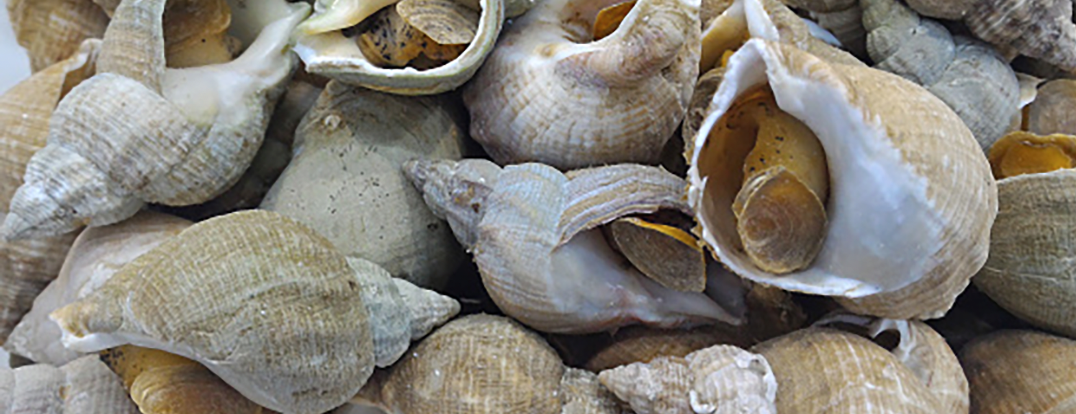
Pop quiz: What are the state colors? You guessed it (or maybe you didn’t!): blue, green, and cranberry, which was made official on February 21, 2005. Most schoolchildren in the Commonwealth are also taught that the state bird is the Black-Capped Chickadee (how many of you wrote a report on one? I did, in the third grade!). But did you know we also have a state shell? We do indeed, and it’s called the New England Neptune (Neptuna lyrata decemcostata), and it was given this esteemed designation on June 26, 1987.
The New England Neptune is also called by its common name, the wrinkled or rigged whelk; technically, that makes it a sea snail. While it is common in local waters, and often caught in lobster traps, you’re not likely to find one washed up on any of our local beaches, according to the Boston Malacological Club, who sponsored the legislation. That’s why we didn’t name this article “Sightings.” But if you do spot one, be sure to let us know!