

CIA Brief | 2026 Spring
President’s Brief
Charya Peou
With spring just around the corner, our team is hard at work preparing to welcome everyone back after a long, snowy winter. As soon as the last of the snow melts, we’ll be busy setting up the park and parking lot, ensuring everything is ready for another vibrant season. We’re still looking for a few more summer agents to join our team—if you’re interested in being part of something meaningful, reach out via email for details.
Mark your calendars for our opening day party on May 24—it’s the perfect opportunity to stop by, say hello, and learn more about our mission. Discover how you can get involved and make a difference in our community. Throughout the season, we’ll be hosting a variety of fun events, so keep an eye on the articles below for updates on what’s coming.
While we’re excited for the season ahead, we appreciate your patience as we work on some important updates behind the scenes. Our website is currently undergoing improvements, so membership renewals will be on hold until early May. In the meantime, donations are always welcome and go directly toward supporting our initiatives.
The Clifton Improvement Association thrives because of people like you. If you’d like to get involved, share ideas, or have suggestions on how we can better serve the community, we’d love to hear from you.

Spring Events
From star gazing to bunny rabbits, April showers bring… April events at the CIA!
Alexa J. Carr & Sheryl Levenson
We hope you all survived this very New England winter. But now it is time to “spring” into some new and exciting programs for our members and the community to enjoy.
In April, we are offering two events:
An Easter egg and matzoh hunt, complete with live bunnies to pet, will take place on Saturday, April 4.
A star-gazing party, offered by The North Shore Amateur Club, we’ll be hosting at Beach Bluff Park the evening of Earth Day, on April 21.
We emailed a flyer to our members about both events, which are now open for registration via our website.
While some other events are in the works (and of course we will also offer our second annual pumpkin event), we invite your input and participation as we continue to develop programming for the coming year. Do you know someone who might want to do a demonstration on cooking with ingredients off the land and sea, teach sandcastle building, or offer a how-to on making wreaths or other crafts with found items from nature? Or how about talks on sharks (which we have done in the past), whales, dolphins, or other sea creatures? The sky’s the limit! Please send your ideas to: VicePresident@ciabeachbluff.org.
See you at the beach!
Vernal Equinox
James F. Keating & Son
The Marlinspike Sailor of Marblehead
MARCH 20, 2026
What exactly happens on March 20, 2026, at 10:46 a.m., EDT? Those of us in the Northern Hemisphere say it’s when the Vernal Equinox occurs. But with most of us, we think the Equinox is when there are equal amounts of daytime and nighttime. However, that occurs on March 17, 2026. On that date, the Sun rises at 6:53 a.m. and sets at 6:53 p.m., EDT. Then what happens on March 20, 2026, at 10:46 a.m., EDT?
Hopefully, the following will help.
First: The Ecliptic, called the “Road of the Sun,” is seen from Earth’s yearly orbit around the Sun. From Earth it looks like the Sun moves against the background of the stars.
Second: The Celestial Equator. We know the Earth has an imaginary line around the middle of our planet. It divides the Earth into two halves, the Northern Hemisphere and Southern Hemisphere. The Celestial Equator is directly above Earth’s Equator and divides the sky into these two equal hemispheres.
In the subpolar point date graph, the curved red line is the Ecliptic. It goes from 23.4 degrees South to 23.4 degrees North and returns to 23.4 degrees South in a year. The 0-degree straight line is the Celestial Equator. When the Ecliptic intersects the Celestial Equator as seen from Earth, those are the Equinoxes (Vernal and Autumnal).
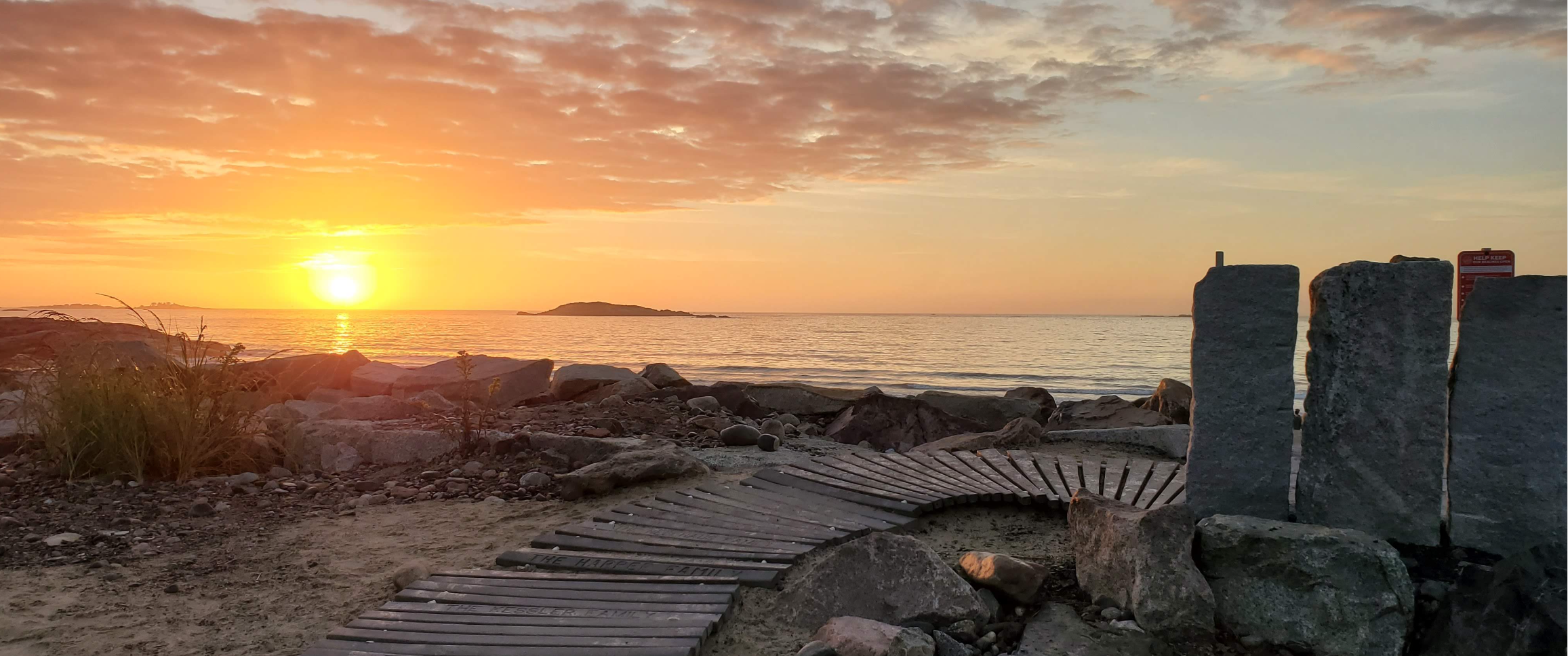
Please join us on Friday, March 20, at 6:47 a.m. to see the sun rise on the Vernal Equinox at the Sun Circle on Beach Bluff Park in Swampscott facing Preston Beach. We are delighted to offer a ceremony to welcome Spring led by Lisa Kawski and Kampa Vashi Deva.

Sightings: The Baffling Buffleheads
Sheryl Levenson
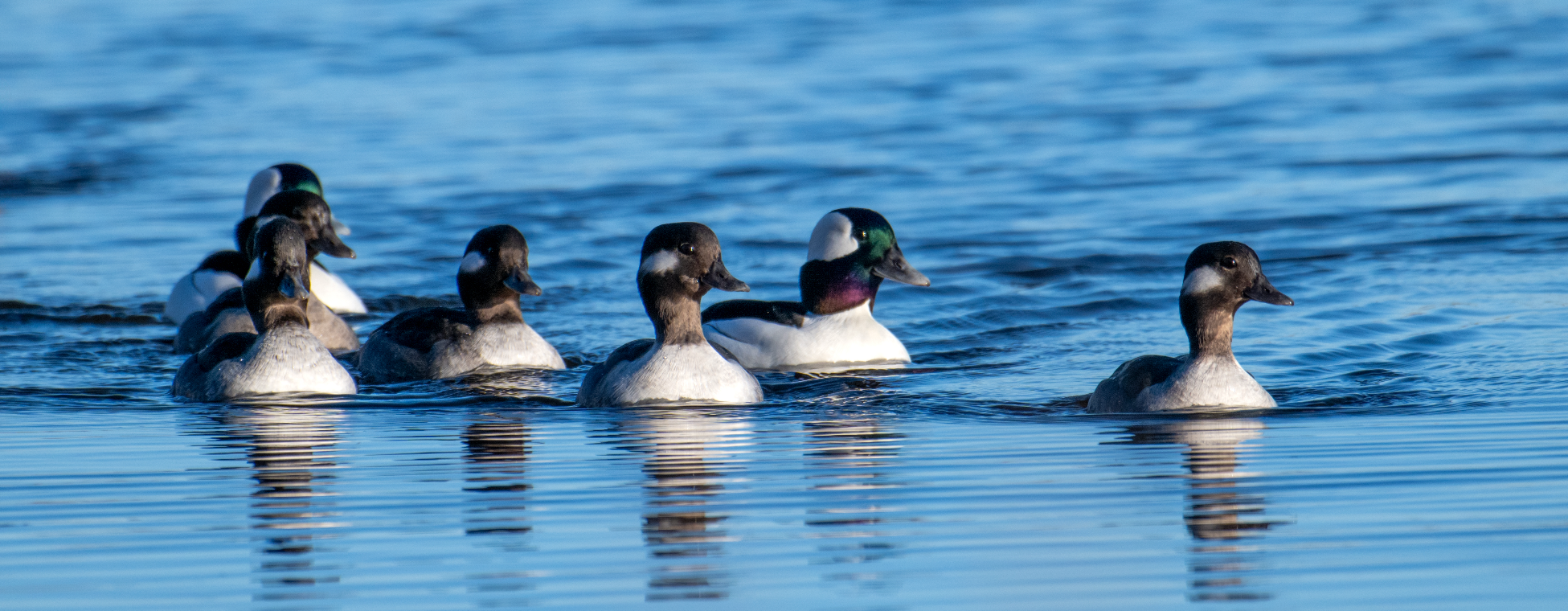
As we look out into the ocean, we see many sea birds. One of the many species of duck is the Bufflehead. Its name comes from “buffalo-head” because the male’s large puffy head was thought to resemble a buffalo’s head. Its name was shortened from the original version, which was “Buffalo Head.”
The Bufflehead may have a large head, but it is actually a small buoyant duck that disappears under the water to feed. They are the smallest diving duck in North America. The males look black and white from a distance, but on closer look, the head is a glossy green and purple with a white patch. Females are a grayish brown with a white patch on the cheek. They will nest in old woodpecker holes, mostly those made by Northern Flickers.
Buffleheads are mostly monogamous, often remaining with the same mate for several years. You will hear the male Bufflehead give a chattering-like song when courting. He will throw his head back and quickly bob it up and down. If the female is interested, she will make a guttural sound that makes her body looks like it is shaking. She will lay about eight to ten eggs. The Bufflehead may be found across the continent and can live up to 18.7 years.
If you see one, let us know; or better yet, post a photo on our Facebook page!