

CIA Brief | 2023 Winter

President’s Memo
Kelly Upham
Happy Holiday Season!
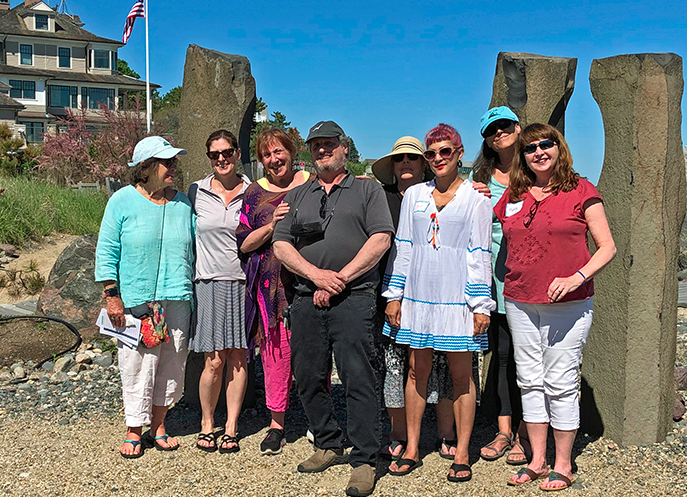
During this season of thanks, I want to acknowledge your continued support and contributions which directly go toward making our park and beach safe and accessible. As a case in point, you may have noticed some heavy equipment by the beach and contractors doing some work to repair our seawall to keep it secure through the winter storms. We could not have engaged them in this important work without you!
I hope you had a chance to join our impromptu gathering at the beach on October 28 to witness a Mother Nature’s trifecta of a full moon rise, ultra-low tide, and sunset all within 10 minutes of one another, with a small lunar eclipse thrown in for fun. One of our former board members, Lauren Lautner, initiated this joyful family gathering only that morning, but word spread, and we were grateful to see so many of you. We plan to be on the lookout for such gathering opportunities in the future.
If you’ve enjoyed reading the engraved planks in our park, please consider purchasing one for yourself or as a meaningful gift. During the month of December, as we do every year, we are offering the holiday discount price of $200 (regular price is $250). Orders will be accepted through our website: December Gift Plank.
Finally, on behalf of our board and contributors, we wish you and yours a wonderful holiday season!
CIA Accomplishments for 2023
Sheryl Levenson & Roberta Chadis
Dear Members,
The Clifton Improvement Association (CIA) Officers and Board of Directors want to express our gratitude for your support over the years. We strive to offer educational programs for many interests while supporting our important mission to preserve and protect this beautiful and special place. Maintenance of our property, which includes Beach Bluff Park, the parking lot, and our seawall, consumes most of our time and money. We could not do any of this without your donations and patronage. Our heartfelt thanks goes out to all of you.
In this year-end newsletter we’re excited to share our major accomplishments of 2023. Plans are already underway for another slate of mission-driven events in 2024.
Wishing you Happy Holidays and Happy New Year, all in good health!
2023 CIA Year-in-Review
Events and Education
How to Safely Co-Exist with Coyotes and Keep Pets Safe: Dan Proulx, Problem Animal Control Agent. Held at Swampscott High School (March)
Sun Circle Events: Vernal Equinox (March), Summer Solstice (June), Fall Equinox (September)
Opening Day Celebration on Memorial Day Weekend: Beach Bluff Park (May)
White Shark Event: Held at UU Church of Greater Lynn in Swampscott (October) *See article below on event
Raptors are the Solution: Held at UU Church of Greater Lynn in Swampscott (November) *See article below on event
Tailwinds: Live bird presentation at UU Church of Greater Lynn in Swampscott (November) *See article below on event.
COMING UP: Winter Solstice. Mark your calendar for December 21st at 7:05 a.m. Join us as we welcome winter at the Sun Circle at Beach Bluff Park overlooking Preston Beach. Lisa Kawski and Kampa Vashi Deva will guide our seasonal sunrise ceremony.
Communication
Quarterly Newsletters: Each quarter the Communications Committee puts together our newsletter, CIA Brief, which is sent to all members.
Kiosk Information: Pertinent information is displayed on kiosks in the parking lot and at Beach Bluff Park. This year we updated the printed information and signage and replaced the worn glass.
Maintenance and Repair
Sea Wall Repair: The CIA is responsible for the upkeep and maintenance of the portion of the seawall on our property. This year we needed to fill in many holes where the stones had been washed out by the ocean.
“No Parking” Sign: For safety purposes, no vehicles are permitted in the right of way off Atlantic Street next to the park. Signage has been installed to alert the public.
Beach Cleanup: The CIA participated in two beach cleanup events in collaboration with other local organizations.
“Sea Weeding” Parties: These monthly “weeding parties” are a fun way to meet other CIA supporters while clearing weeds in the park. All volunteers are greatly appreciated!
Parking Lot and Park Upkeep, including Landscaping: Efforts include irrigation, ongoing care during summer months, and storm damage cleanup each spring and after other ocean storms. This year wasn’t the worst on record, but we still had our share of cleanup to do.
Plank Installation and Maintenance: Planks are installed in the park as walkways and these need adjustments every spring. You can purchase a plank to remember a loved one, a pet, a special occasion, or for any reason you like. We are offering a $50 discount in December; planks are $200 if you purchase before the new year. Visit www.ciabeachbluff.org for more details.
Community Safety and Summer Agents
Pushbutton Crosswalk Signage: After substantial research in collaboration with the town of Marblehead, the CIA is happy to have installed crosswalk equipment to keep our members and larger community safer when they cross Atlantic Avenue.
Parking Lot Management: We are grateful for the students who choose to be agents in our parking lot every summer from Memorial Day through Labor Day.
Porta Potties: The CIA provides these bathroom facilities for the convenience of beachgoers. We hope this makes it easier for all to enjoy their day at Preston Beach.
Atlantic White Shark Conservancy: How to be Shark Smart
Roberta Chadis and Sheryl Levenson
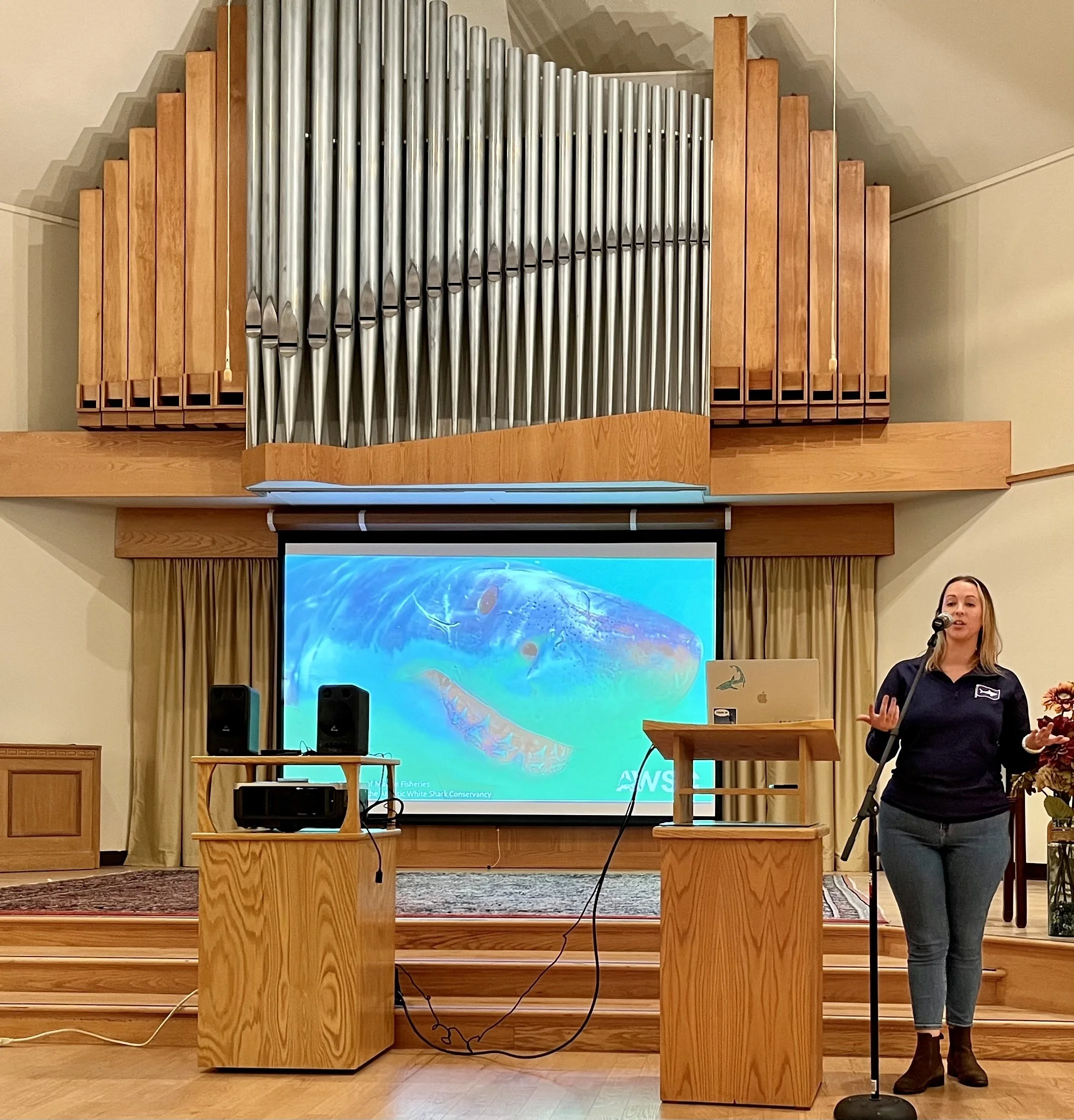
In October this year we were excited to restart our in-person education events, kicking them off with a talk on white sharks off our coast. We presented this event with our co-sponsors, the Swampscott Conservancy and the UU Church of Greater Lynn in Swampscott, who hosted the event. Kristen Smith, Community Engagement Manager for the Atlantic White Shark Conservancy (AWSC), presented a scary but wonderful and informative talk about the white shark research projects being funded by AWSC and their impact on shark conservation and public safety.
One part of the research is to identify the sharks and tag them. “Turbo,” named for his speed, is 10 feet long with a mark shaped like a “W” and scarring on his face. Kristen screened a short video of the tagging process. While over 600 sharks have been identified, only 300 have been tagged. Of curious interest was that the great white is not the best hunter; they tend to lose more prey than they capture. Kristen also pointed out that what we see depicted on television is not often accurate: for instance, sharks do not like to swim with their dorsal fins above water as they prefer to remain hidden.
Some other fun facts: Did you know the average lifespan of a white shark is 70 years? In 2022, four sharks were detected in the Marblehead area, and they swam by the detector 19 times. Surprisingly, sharks are still active in October. This means that surfers and swimmers should take care when going out even after the warm summer months.
If you’d like to view a video recording of this event, please visit our website at www.ciabeachbluff.org.
Raptors are the Solution
Sheryl Levenson
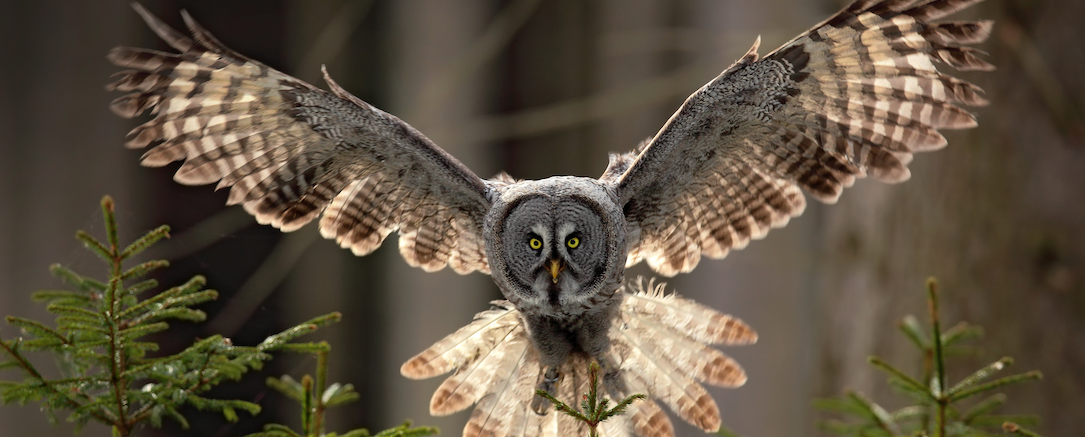
On November 8, the Clifton Improvement Association (CIA), together with the Swampscott Conservancy and the UU Church of Greater Lynn in Swampscott, cosponsored another informational program titled “Raptors are the Solution.” It focused on the dangers of rodenticides and how they harm and destroy our wildlife and pets. Some examples of bird species that are considered raptors are eagles, falcons, hawks, and owls. They use their sharp talons to capture prey and defend themselves.
Our speaker, Laura Kiesel, is a naturalist, conservation advocate, and award-winning environmental journalist. She is the founder of Save Arlington Wildlife. We all remember the horrible tragedy and loss of MK, the bald eagle in Arlington who died from rodenticide poisoning. Rodenticides are killing our wildlife, including sensitive species like the bald eagle, snowy owl, and many other animals. Laura reviewed facts about this poison and the effects it has on our health and environment, while providing us with practical solutions. Our raptors are the best form of control of the rat situation. We should not wait until it is too late to protect them.
Please visit our website, www.ciabeachbluff.org, to watch the video of this presentation.
The Threat of Rodenticides to Wildlife
Toni Bandrowicz, President, Swampscott Conservancy
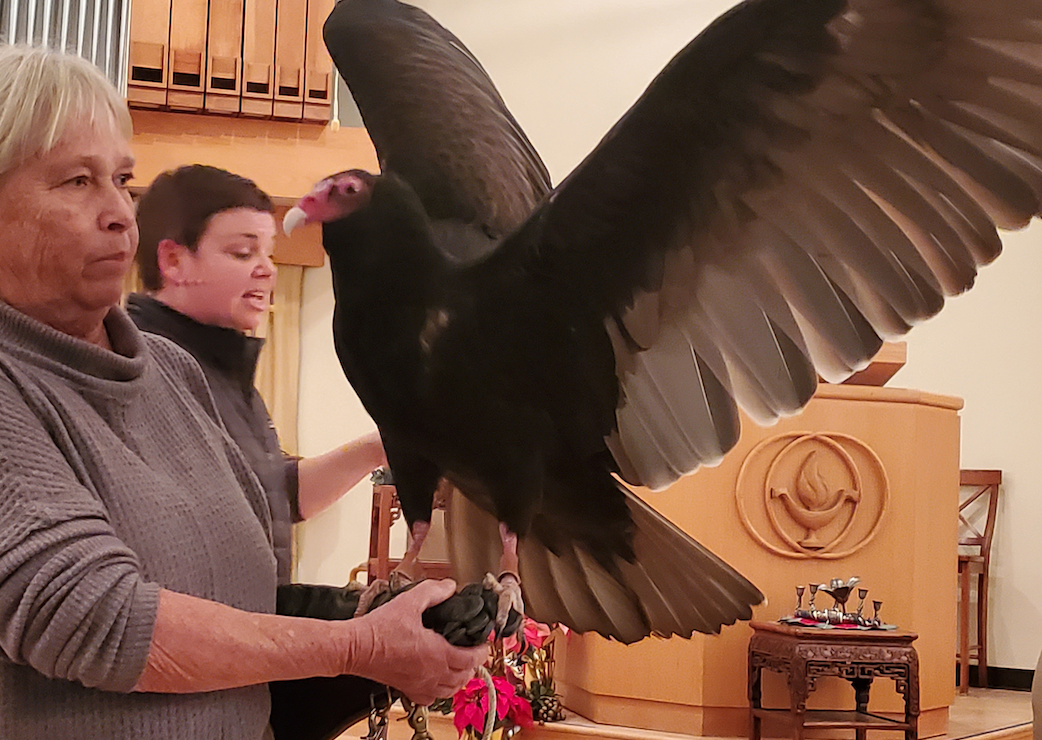
On November 29, 2023, a barred owl, a red-tailed hawk, and a turkey vulture paid a visit to the Unitarian Universalist Church of Greater Lynn in Swampscott—and I don’t mean outside. Rather, they came right into the church sanctuary. But they were invited! These three birds of prey were part of an informative presentation put on by Tailwinds, a local nonprofit that offers environmental and conservation education programming. https://tailwinds.live/
Sponsored by the UU Church, the Clifton Improvement Association, and the Swampscott Conservancy, the program, which was presented by two of the founders of Tailwinds, Sarah Kern and Linda Noon, gave the adults and kids in attendance not only an opportunity to learn some interesting facts about these remarkable creatures, but to observe them close up.
There can be no argument that the hawk, with his regal countenance, flew away with the “most majestic” award of the night; and the owl, talons down, won the “most adorable” award. But for me, “Greta,” the turkey vulture, was the surprise of the evening, as I never thought I’d find meeting a vulture an enjoyable experience.
Greta, who clearly delighted in showing off her six-foot wingspan, doesn’t have sharp talons and a curved bill to kill her prey like other raptors; she is a scavenger. Like other vultures, she eats carrion (that is, the dead and rotting flesh of animals). And, with her extraordinary sense of smell, she can detect carrion from over a mile away!
One especially fun fact, particularly for the younger members of the audience, is that, as a defense mechanism, turkey vultures can projectile vomit up to ten feet away on any bird, animal, or human who gets too close. This ability was not (thankfully) demonstrated during the Tailwinds presentation, though all three birds did occasionally leave deposits of another kind on the floor, which were quickly cleaned up.
Because of what they eat, vultures tend to have a bad reputation, but actually they provide an important service by ridding the environment of dead animals that would accumulate and potentially spread disease. The digestive juices in a vulture’s stomach are extremely acidic, so it can digest just about anything, allowing it to eat carcasses tainted with anthrax, tuberculosis, and rabies without getting sick.
Threat to Birds of Prey from Rodenticides
But like other birds of prey, there is something turkey vultures can’t ingest, and that’s animals tainted with rodenticides, in particular second-generation anticoagulant rodenticides (or SGARs). Commonly used by exterminators, SGARs are placed in those ubiquitous black bait boxes you see outside buildings. Because SGARs stop the natural blood clotting process, rodents that eat the bait slowly die. As they sicken, they become an easy target for eagles, hawks, and owls. Unfortunately, like the vultures, these birds will also succumb to death by a slow internal bleeding.
There are many documented cases of birds of prey being poisoned by rodenticides in Massachusetts and elsewhere. This sad fact was brought to light in a November 9, 2023, in a presentation by Laura Kiesel, wildlife biologist, naturalist, conservation advocate, and founder of Save Arlington Wildlife. savearlingtonwildlife.org
Her presentation, entitled “The Rat Poison Problem: How Rodenticides Are Harming Wildlife, Pets, and People,” was also hosted by the Church, the Clifton Improvement Association, and the Swampscott Conservancy. If you missed her talk, you can watch it at youtube.com/watch?v=4vGqvM80Yk8.
Kiesel explained how numerous birds and other animals are poisoned by SGARs each year, including a Bald Eagle nicknamed “MK,” who was known and loved throughout the Mystic River watershed. And MK was not an isolated case. New studies and reports confirm that these rodenticides are killing an increasing number of birds of prey throughout our larger neighborhood of New England.
How can you help?
First, become educated on the issue: start by reading the information on Save Arlington Wildlife’s website: savearlingtonwildlife.org
Second, write to your select board or city council urging them to ban the use of SGARs on municipal-owned properties.
Third, support the following state legislation that can lead to the restriction or banning of SGARs. More information on these bills and how to contact your state legislators can be found at: savearlingtonwildlife.org/ways-to-get-involved/
H.814/S.540 would return power to towns and cities to regulate pesticides by abolishing the state law that currently prevents municipalities from banning or restricting SGARs on private property. You can also urge your town or city to submit a Home Rule petition to the state government asking for a waiver from this state law and allowing your community to regulate SGARs.
H. 825/S.487 “An act relative to pesticides” (also known as the “Hawkins bill”) would require a state registration database to track SGARs use in the state and promote education and awareness about these poisons. The Animal Legal Defense Fund also has an on-line form to ask your state legislator to support this bill: aldf.org/project/protecting-animals-from-rat-poisons-massachusetts
Finally, as pointed out on the Save Arlington Wildlife website, there is no comprehensive peer review data showing that rodenticides like SGARs are actually effective at meaningfully reducing rodents, particularly in suburban communities, and may actually be a contributing factor to rodent infestations. There are alternatives to rodenticides and steps that individuals can take as shown at savearlingtonwildlife.org/alternatives-to-rodenticide/.
It's up to us to speak up for eagles, hawks, owls—and vultures like Greta—who frequent our neighborhoods, and to care enough to protect them from the lethal effects of poisons like SGARs.
CIA Board Member Dossier: Meet Krissy Sgambellone, Treasurer
Julianna Thibodeaux
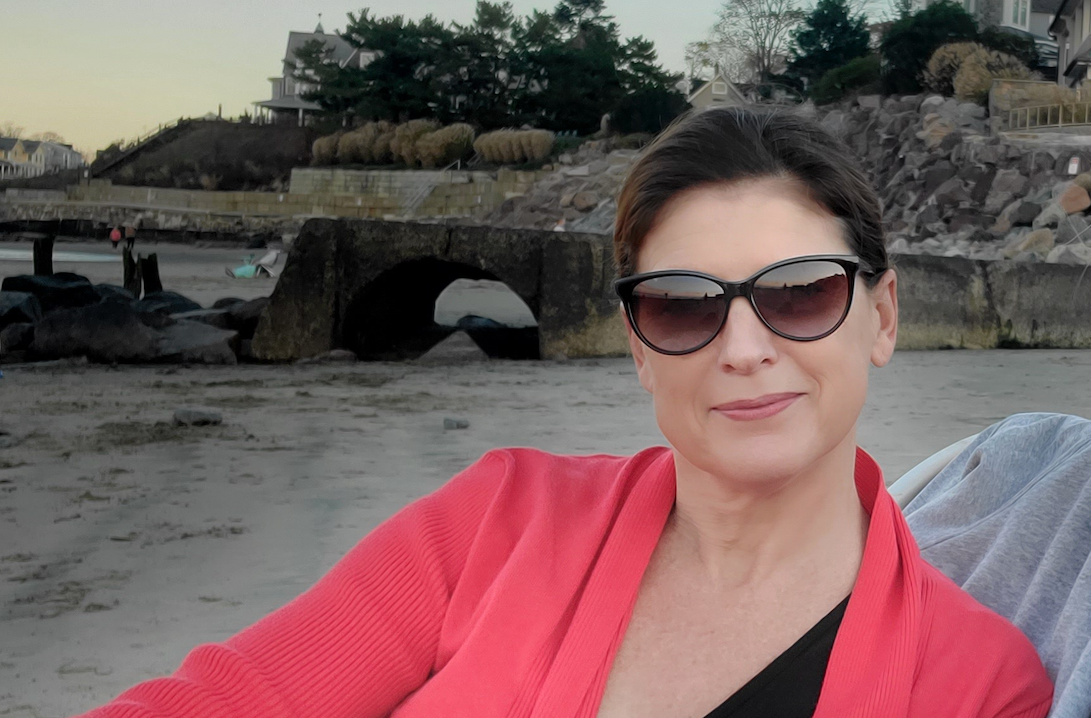
Welcome to the first installment of a new column in CIA Brief in which we introduce you to the CIA’s volunteer board members who manage all aspects of the organization, from policy-making to bookkeeping to producing this newsletter (and a great many points in between). To kick off this new feature, we introduce our treasurer, Krissy Sgambellone, who signed on last spring to fill the generous shoes of long-time treasurer Philip “Phil” Lee. We are eternally grateful to Phil for his diligence and careful numbers-crunching and to Krissy for bravely taking up the baton.
JT: Please share a bit of your background with our readers. Where did you grow up? How long have you lived in Marblehead and/or Massachusetts?
KS: I grew up in Amsterdam in upstate New York, northwest of Albany. My husband and I moved to Marblehead in April of 2012, just a few months before we had our daughter.
JT: How did you become involved in the CIA?
KS: My friend Charya is on the board. We spend a lot of time together at the beach, and she encouraged me to join. I took her up on it when my schedule cleared up a bit, giving me more time that I could commit.
JT: What is your “day” job, and what are the intersections between what you do professionally and your role as treasurer?
KS: Yes, they do intersect to some degree. I am the Managing Director of Operations and Human Resources for a local charter school. My day-to-day at work includes planning, facilities, logistics, and work on the budget. I am on the Financial Committee for the school, which has been very helpful while learning the financial processes of the CIA. I became the treasurer after the start of the last beach season, and it was a bit overwhelming at the time. Moving into next season, I hope to also lend my experience with human resources.
JT: What are your goals as treasurer of the CIA?
KS: I hope to help maintain the sound financial operations of the CIA and to help move us forward. I would like to see the organization continue to grow and continue to be financially prepared for each season. There is no telling what Mother Nature is going to throw our way, which is always in the back of our minds. The financial responsibility that is tied to cleaning up and completing repairs after storms and after each winter are real wild cards. I want to help ensure that we continue to be prepared and able to maintain the park.
JT: What are the primary challenges smaller organizations such as the CIA face when it comes to “keeping the books”?
KS: The primary challenge for me so far has been learning the systems that were put into place by former treasurers. We are a small organization, dependent on volunteers, and we lack mainstream accounting tools. The folks before me created the systems that we are using to balance the books each month. Learning this independent accounting system has been a challenge, but in the end, it works!
JT: What are the CIA’s strengths as an organization?
KS: The strength is absolutely found in the volunteers who have poured themselves into the success of the association. The CIA would not be what it is today without this dedication and commitment. The first meeting I attended was online during COVID, and by the end I was just in awe of these folks. The number of years of commitment they have given was so inspirational. I committed to the group that night and have not looked back.
JT: We are so glad you took a chance on us! What do you like to do in your “free” time?
KS: I like to spend time with my family—going to concerts, traveling—and of course going to the beach!
JT: Please share a favorite memory of the park and/or beach!
KS: I have so many amazing memories at the beach. I watched my daughter and her friends grow up there, and I’ve spent countless hours laughing and enjoying lazy afternoons and beautiful sunsets.