

CIA Brief | 2021 Fall
President's Brief
We hope everyone has enjoyed a nice summer and that the use of our parking lot enabled many of you to enjoy Beach Bluff Park and the beach! Unfortunately, the Board decided to limit memberships this summer in order to avoid too many “Lot Full” days which, in turn left some unable to join. It is a delicate balance that the Board discussed at length and one that we continue to work to improve.
And since the lot doesn’t run itself, we would like to give thanks to our awesome lot attendants for a job well done: Ella Kramer, Evelina Thibodeaux, Colin Burke, Hannah Crowley, Danny Solomon and Brady Lavender as well as their coordinator, Mike Lavender… we hope they all have a great school year and return next summer!
We also offer thanks to Don Orne and Roberta Levy for their many years of service on the board and wish them both good health and happiness. We are actively looking for people to get involved with our board so please send me an email if you’d like to attend one of our monthly meetings to learn more.
Enjoy the shift into Fall and all the pretty colors and sunsets it brings!
Kelly
In Rememberance
Louie Gallo
Louie Gallo, beloved Swampscott historian, died tragically in a house fire in July at the age of only 78. Louie was widely known, well respected, and anyone who met him could immediately see he was a larger-than-life gentleman. He was always willing to help, and with a smile. A lot of us, including the CIA, relied on his encyclopedic knowledge of town history. He was the kind of person you were happy to see, and he welcomed everyone as if they were family. His passing has left a huge hole in my heart and I'm sure anyone who knew him feels the same.
He will be greatly missed.
- Sheryl Levenson
To learn more about Louie’s life and legacy, visit https://www.bisbeeporcella.com/obituaries/Louis-A-Gallo?obId=21771002
Celestial Happenings
Charting the Autumnal Equinox
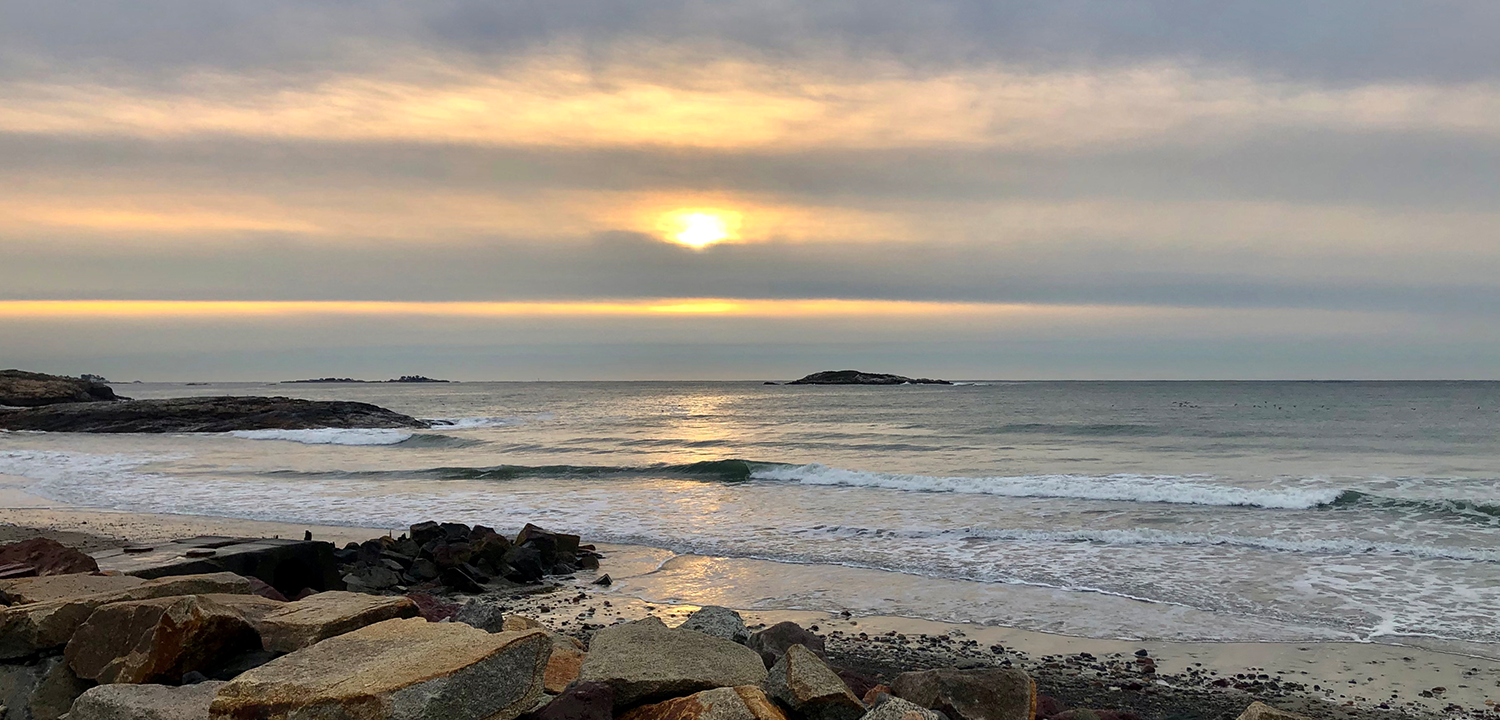
Thank you to Jim Keating for this fantastic look at the path of Earth in relationship to the Sun at the Fall Equinox:
Three months after the Summer Solstice in June, when the Sun was at its northern most point on the ecliptic (the path of the Sun during the year), it (the Sun) has been traveling south and has been overhead for places like Mexico, southern Egypt, and southern China.
Of course, the Sun is not moving; the Earth’s orbit makes it look like the Sun is moving, but it took us Earthlings a few years to figure that out. Thank you, Copernicus and Kepler.
So, the Sun is slightly farther south in the sky each day. The days have gotten gradually shorter.This year on September 22 at 3:21 p.m. EDT, the Sun comes to the second place where the ecliptic crosses the celestial equator. At that moment of crossing the celestial equator, the Sun is overhead on the equator of Earth.
After that, it is now Fall or Autumn in the northern hemisphere and Spring in the southern hemisphere.If your birthday is in September, your Astrological sign is Virgo.If you come to the Sun Circle tonight and look to the south, you see the constellation Sagittarius. Why?
This question to be answered at the Autumnal Equinox on September 22 at sunrise at the Sun Circle at Beach Bluff Park.
--Jim Keating, the Marlinspike Sailor of Marblehead, Bylandseaair: 42*30’27”N 70*51’5”W
Down and Out
A Q&A on the Preston Beach Outflow Pipe
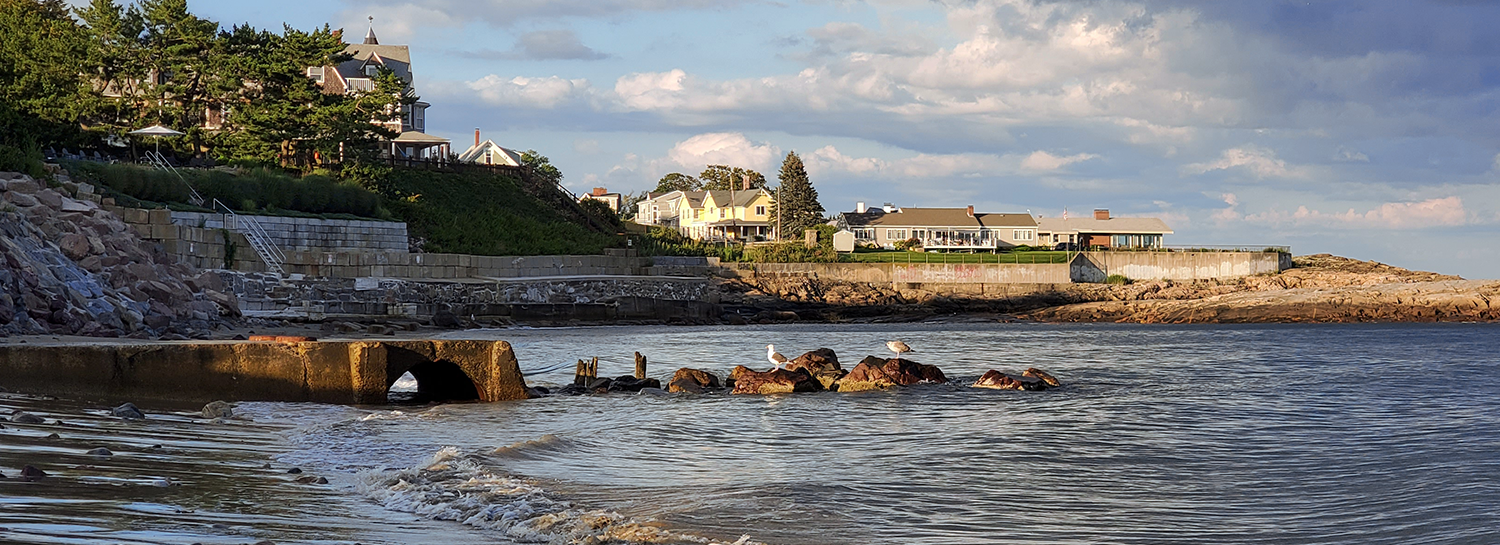
The outfall pipe at Preston Beach, just to the left of the beach stairs as you face the ocean, is a source of amusement for many. Particularly after a heavy rain, kiddos love to frolic in the water that flows with even greater urgency after a heavy rain. Kids and adults alike might wonder, where does the water come from? Is it safe to play in?
To find out more about the outflow pipe, the CIA’s Sheryl Levenson reached out to Gino Cresta, Director of the Town of Swampscott’s Department of Public Works (DPW) since 2003. The DPW performs a myriad of tasks ranging from water control to plowing to maintenance of the town’s public parks and beaches. Cresta is also Swampscott’s Assistant Town Administrator and manages multiple town custodial positions, including those for the Swampscott Public Library and the Swampscott Town Hall.
Both personally and in his official capacity with the Town of Swampscott, Cresta is dedicated to keeping Swampscott clean and beautiful. Cresta graduated from Merrimack College with a BS Degree in Civil Engineering and is a lifelong Swampscott resident. His three children graduated from the Swampscott School system.
When it comes to the outflow pipes around town, the most important message Cresta would like to pass along is to dispel the misconception that catch basins discharge into the sewer system. In reality, anything that gets dumped into catch basins and storm drains ends up being discharged onto town beaches.
Levenson: What is the purpose of this structure?
Cresta: To discharge water from Hawthorne Brook, as well as stormwater collected by approximately 150 storm drains.
Levenson: When was it built?
Cresta: 1935.
Levenson: Where does the runoff originate and what is its path?
Cresta: As far back as the rear of the Swampscott Cemetery. It meanders across Paradise Road, through the golf course, down Dale Street and Bradlee Ave., and then onto Preston Beach.
Levenson: How often is it tested?
Cresta: Twice a month during the summer by the Board of Health.
Levenson: How often is it inspected and what are the results?
Cresta: It is inspected yearly for dangerous rebar exposure and any other hazards.
Levenson: How often are the catch basins cleaned that collect the fallout water?
Cresta: Yearly.
Levenson: Is the water safe to walk in?
Cresta: Yes.
Levenson: When do you expect repairs to be made to the pipe?
Cresta: Unknown at this time. The Stacy’s Brook Outfall is the priority due the EPA Consent Order.
Levenson: What can we do as beach goers to help maintain its function?
Cresta: Inform all residents that anything that they put into a storm drain will eventually end up on one of the town beaches.
Levenson: Are there outfall pipes like this on other beaches?Cresta: There are 27 outfalls of various diameters that discharge onto the town beaches, four of which have concrete culverts that extend onto the beach – Preston, Eiseman, Fisherman’s, and at Cassidy Park. The Stacy’s Brook Outfall is the largest and measures 6 ft x 10 ft.
We hope you found this information helpful and informative.
Sightings
Piping Plovers
Charadrius melodus
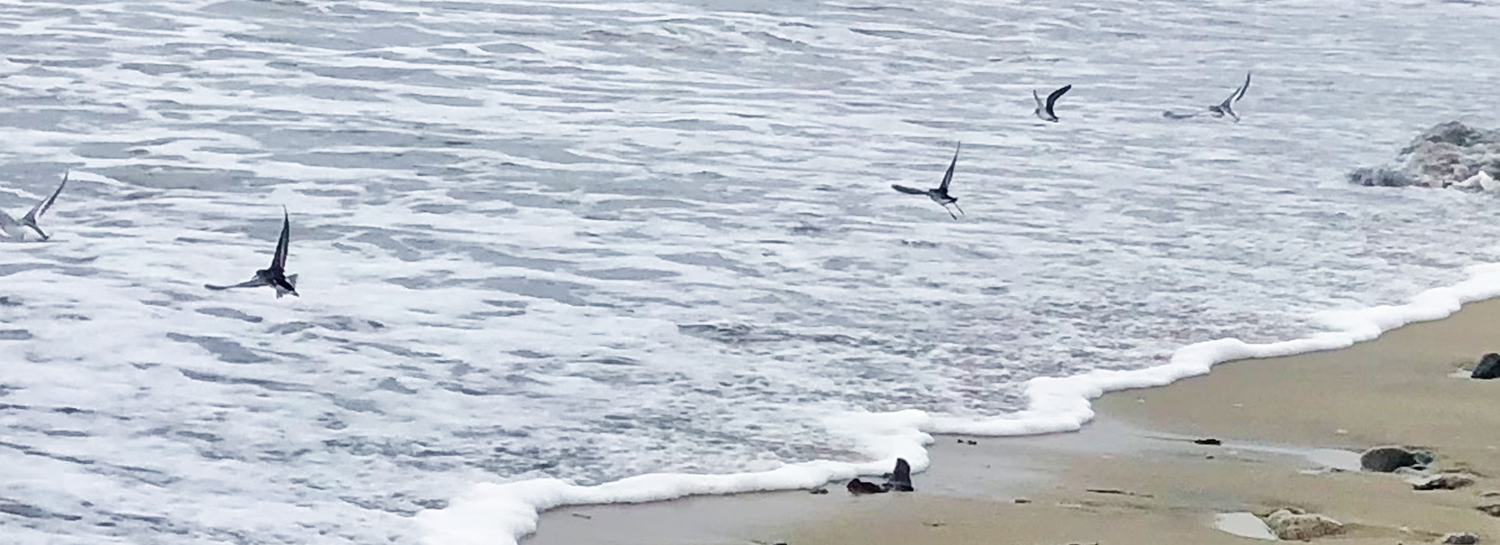
Have you noticed the tiny shore birds that dot the shoreline during the summer months? These adorable and energetic creatures are piping plovers, shorebirds that are noticeable on our Massachusetts beaches—including Preston Beach—as they forage for food along the water’s edge (see text box). Although the birds move fast, they are easily identified by their distinctive small size and prevalence, despite their sandy coloring that camouflages them in their littoral habitats.
You’ll notice the bird’s distinctive pattern of running in brief starts and stops. White wing stripes give a picture of full regalia while in flight with their 14-to-16-inch wingspan, despite their small size at just six to seven inches in length. The piping plover calls in a series of piping whistles, although it may be difficult to hear against the sound of wind and waves.
These little birds feed primarily on marine worms, mollusks, insects, and crustaceans, which they find along the waterline, in mudflats at low tide, and at high tide, in “wrack”—the marine vegetation and debris washed up by the incoming tide. The birds have a surprisingly lengthy life span of 16 years or more.
If you happen to discover a piping plover nest along the high tide line where the sand ends and the dunes begin, don’t tread on it. These beloved Atlantic Coast seabirds are listed as Threatened in both Massachusetts and at the federal level. According to the Massachusetts Division of Fisheries and Wildlife, in 1986, there were only 140 breeding pairs of piping plovers in Massachusetts. While the population has increased to 700 breeding pairs, the global population of piping plovers is less than 10,000 adults, “less than the number of people on a popular beach on a hazy August afternoon.”
For more information on these delightful birds, take a look at the following article from the Massachusetts Division of Fisheries and Wildlife: https://www.mass.gov/service-details/learn-about-piping-plovers
Look for it!
See if you can identify a piping plover on your next beach walk:
• pale brown, gray, or sandy colored on the backside
• underside, forehead, cheeks, and throat are white
• a black streak extends from one eye to the other
• black breastband (may not always form a complete circle)
• tail is white at the base and tip, but dark in the middle
• legs and bill are yellow-orange
• bill has a black tip in summer that turns completely black in winterIf it’s not a piping plover, perhaps it’s a semipalmated plover (Charadrius semipalmatus). These birds that are similar in size and shape, but darker brown with more black coloring on the head.
Credit: Mass.gov, Dept. of Fisheries and Wildlife